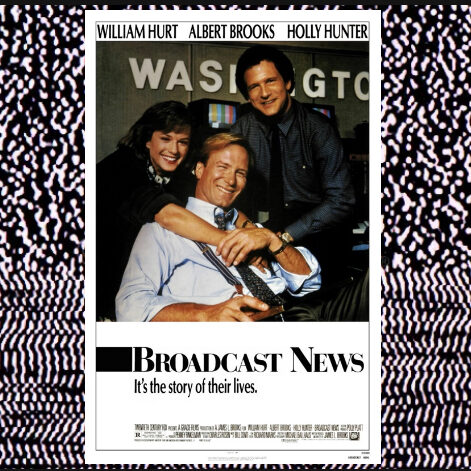
Release: 1987
Director: James L. Brooks
Writer: James L. Brooks
Genre: Romantic Dramedy
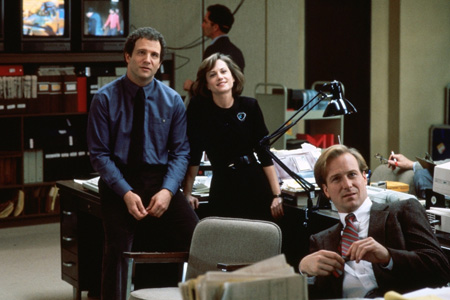
While many films feature the media on the periphery of characters’ lives, Broadcast News takes us into the heart of news media of its time (specifically, 1987) as it undergoes its own character development. Here we follow characters who represent elements of the broadcasting cycle, and watch them impact this industry the way most films have the industry impact their characters. This story centres around Jane, a headstrong news producer with a passion for reporting, who works alongside her fellow reporter and friend Aaron. As dedicated as she is to producing quality, informative coverage for the national network they’re employed at, Jane has to contend with the shift news reporting has been taking towards ‘soft news’, or a delivery of more watered-down coverage that prioritizes style over substance. She finds that her dynamic, well-organized retrieval of information actually works well with the charm and charisma of their new anchor Tom, though she becomes increasingly aware that he embodies the entertainment-focused reporting she fears. This truth is explicitly pointed out by Aaron, who is a talented reporter but too awkward to be in front of the camera, and who likens Tom to a ‘salesman’ who will gradually corrupt the industry. These two men, who enter a love triangle with Jane, acting as opposite ends of the informative reporting/entertaining soft news spectrum seems to represent Jane’s struggle to appease any one of these approaches to news in her difficult job. Aaron is substantive and familiar despite his awkward exterior, yet Tom is easily likeable and appeals to the new age of broadcasting.
This film is valuable as a commentary and time capsule to look back on amidst the current state of journalism, and calls for reflection on both the content of news items and their delivery. Its observation in 1987 that news would continue to shift in favour of entertainment value was accurate given that the following decade would see the birth of Court TV and proliferation of tabloids; the amount of scandals dominating the news from then to now is at least in part due to the news cycle propping them up. The delivery would also develop into shorter, digestible portions, and this shift is particularly relevant in the age of the Internet. With writers being encouraged to keep their pieces short in order to be read, and social media as news source being accepted as the norm, it is more apparent than ever that many of us make less and less time for news in between consumption of entertainment. The domination of the Internet and social media journalism has led to traditional journalism and broadcasting dying out, with remaining members of the industry having to be responsible for practically every job involved in reporting. In the film we see how much collaboration it takes between Jane, Tom and many others at the network to deliver coverage smoothly; maybe we can see now that it isn’t just Tom’s soft news appeal that has brought the decline of broadcast news, but that individuals like him are all that’s left to handle entire stories. Jane’s ultimate inability to commit to either him or Aaron may reflect how neither approach represented by the men is the right one for providing the public of the future with their news; Tom’s is not adequate for what we need to be informed, but Aaron’s isn’t realistic for a public rapidly evolving towards convenience. We need something in between, but people like Jane are increasingly left on their own to try and deliver.