
Release: 2014
Director: David Fincher
Writer: Gillian Flynn
Genre: Thriller/Mystery
Gone Girl, to me, is a story about narratives. By narrative, I mean the particular story that someone tells, either directly or implicitly with whatever tools of expression are available to them, about what has happened or is happening around them. Unlike perspectives which are more internalized reactions to events, narratives are to some extent crafted, but may be influenced by one’s perspective. A narrative, whether it’s shared with others or only told to oneself, isn’t necessarily deceitful, but may simply try to make sense of what is happening. Gone Girl exemplifies how narratives can vary in how truthfully they explain events, from intended honesty to fabrication with some blend of the two in between, all vying for acceptance as the truth.
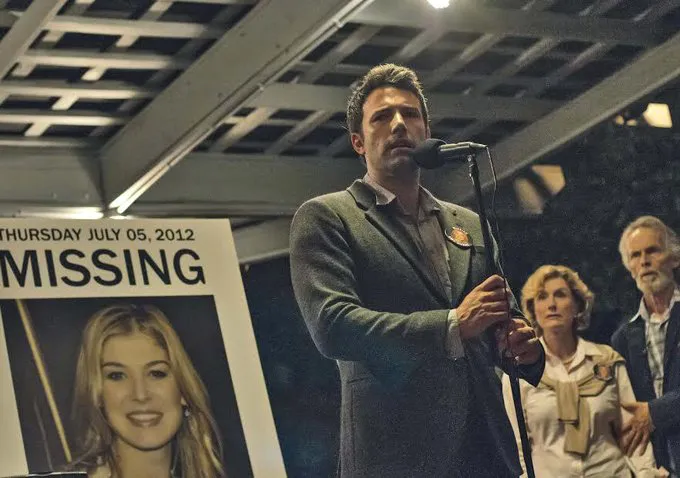
The story begins with a man named Nick who we’re almost certain has killed his wife Amy despite his narrative that he didn’t, mainly because his is interspersed with Amy’s narrative as told through her diary, about his mistreatment and steady incline towards abuse. When looking at her disappearance and evidence of murder, the narrative she has told herself through this diary being shared with us inadvertently points to Nick as her killer, concluding with her suspicion that “he might actually kill me”- case closed. But our understanding of the story completely shifts when we’re presented with a new narrative from Amy, that she speaks directly to us: she has orchestrated her own murder and disappearance in order to frame Nick. This is the point at which we see Amy in a whole new light, but also when we begin to realize how narratives can be constructed strategically which will guide the course of this film. She explains that her ‘diary’ was a fictionalized narrative used to steer the police and public’s understanding of her and Nick’s relationship, taking advantage of the assumption that a diary is an honest confessional. For as much fabricating as Amy does, the key to much of her persuasion is weaponizing honesty. She explains that much of the diary’s content is true, meaning Nick would confirm it, and her greater narrative of bad husband turned murderer heavily relies on his verifiable poor behaviour (most notably that he’s been having an affair). Nick on the other hand struggles to use the truth effectively for his case, be it his faux pas of smiling at a press conference about Amy’s disappearance or trying to hide his affair, and this is something he has to learn. Despite his efforts to manage his honesty and put on the appearance of a concerned husband (which he is, but he realizes that the public has a narrow definition of what this role looks like that he must conform to), Nick struggles to convince the increasingly engaged public of his innocence until he is coached by his lawyer Tanner. With Tanner he learns to weaponize honesty, changing his narrative from ‘completely innocent husband’ to ‘guilty (and remorseful!) of bad husbandry but innocent of murder’, and from there his narrative is in competition with Amy’s. This competition is hosted by the news and entertainment media, whom we can see hold the power to bolster or invalidate certain narratives to sway public opinion. Before he potentially has to prove his innocence in a court of law, Nick must do so in the public consciousness via media appearances, where he is performing his narrative for both the public and Amy. In addition to some setbacks in her plan, she is ultimately persuaded to shift her narrative to take the blame off Nick and return home to him, after being convinced by his expressed remorse on a TV appearance. Her murder plot becomes a miraculous survival story that rewards Nick with legal and public acquittal, so long as he embraces this new narrative. Though he feels trapped in this narrative of mutual protection, he has learned that he is only safe when his and Amy’s narratives are unified. What becomes their story is then ordained by the media as the truth, allowing them reprieve from the now-satisfied public, which is ultimately more valuable than honesty.