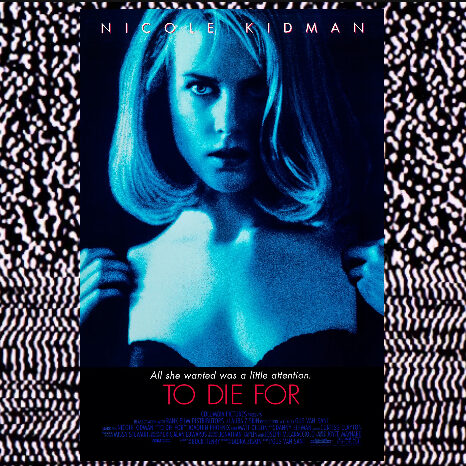

Release: 1995
Director: Gus Van Sant
Writer: Buck Henry
Genre: Dark Comedy/Crime Thriller
Adapted from Joyce Maynard’s novel of the same name, which itself is loosely based on true events, To Die For as a film entangles itself in themes of truth and fiction, and how media can serve to separate or muddle together the two. The film expands on the novel’s entirely-interview format by jumping between interviews with characters and canon enactments of the plot, establishing a ‘truth’ which the audience can compare the characters’ interpretations against. The story that these interviews revolve around, or at least the in-universe reception of the story that has already circulated, is laid out in the film’s opening scene before we are talked through it by the characters: a man’s murder in a small American town has captured national attention, or more accurately, his wife’s alleged role in it has. From this opening montage of tabloids to her introduction, we are made to infer Suzanne’s guilt from her relentless ambition to make a name for herself in television news and her manicured self-presentation (played with uncanny charisma by Nicole Kidman), as much as her number of potential motives. Her feigned innocence and claims about other characters don’t align with the established ‘truth’, and this gets at the film’s point that through reality-based media, the truth is usually not delivered directly. Suzanne’s self-representation (through a videotape she produces herself, free from interviewers’ questions) attempts to deliver her version of the truth to us, but we can understand that it isn’t truthful when we compare it with a) the other characters’ testimonies and b) the film’s metatextual ‘truth’. These three levels of truth (Suzanne’s account, that of other characters, and the film’s ‘truth’) have to interact to deliver the full truth to us as the audience, because one account wouldn’t be reliable enough. The film’s choice to use the interviews and Suzanne’s tape at all to tell the story is indicative of its main theme: that the media at its best reveals the truth, but it must work through humans’ varying levels of reliability to do so.
Humans’ relationship to the media is another major theme of the film; their attitudes toward it and its effect on their lives. Suzanne’s drive to become a news media personality is inherent to most everything she does, and rather than seeing media attention as something that will transform her, she sees it as the natural progression of her life, an inevitable component of her identity. (She even considers her television name to be her “own” name, compared to her married name.) She explains that on television is where we learn about ourselves, by which she means to say that her assertion of her identity as she understands it will become canonized by broadcasting it. This is a motivating factor in her fierce ambition to make it in reporting, and yet her constant efforts to gain experience and market herself are mostly futile. She comes to learn that the most effective means of getting media attention is exploitation. Her first inkling of this comes when she is advised to exchange sexual favours for work in the industry, thus allowing herself to be exploited for exposure. The message really clicks for her after her husband is murdered and she is met with a sea of reporters and cameras outside her door, which she gladly walks into. For all her hard work and ambition, the closest she gets to her media personality dream comes from being the subject of ravenous media exploitation. The film ends with Lydia, Suzanne’s underling who was never particularly interested in media attention, explaining that she has been offered many television appearances for her involvement in the murder plot. This ending cements the film’s point about how media attention is most often something that happens to a person, and thus offers them little agency in how they’re represented to the audience. Suzanne was right in the sense that the media canonizes who we are, but she failed to see that the ‘truth’ of who we are is rarely what we meant it to be.